
Market Update – June 20th, 2025
In the past week geopolitical volatility has intensified in the Middle East and the Federal Reserve updated its views on monetary policy, marking an eventful week as we head into the end of the 2nd quarter.
Middle East Conflict
The overall market reaction has been somewhat muted in response to the escalation of conflict between Israel and Iran – although the S&P 500 fell -1.1% on June 13th, its worst day of the month1, as Iran retaliated after Israel’s initial airstrikes.
The commodities markets have been active, WTI Crude Oil is up from $60.79/barrel at the beginning of the month to $74.80/barrel as of 6/19/2025.2 Disruption to global oil supplies is a lingering concern to the macroeconomy – mainly as a driver of higher inflation in the coming months.
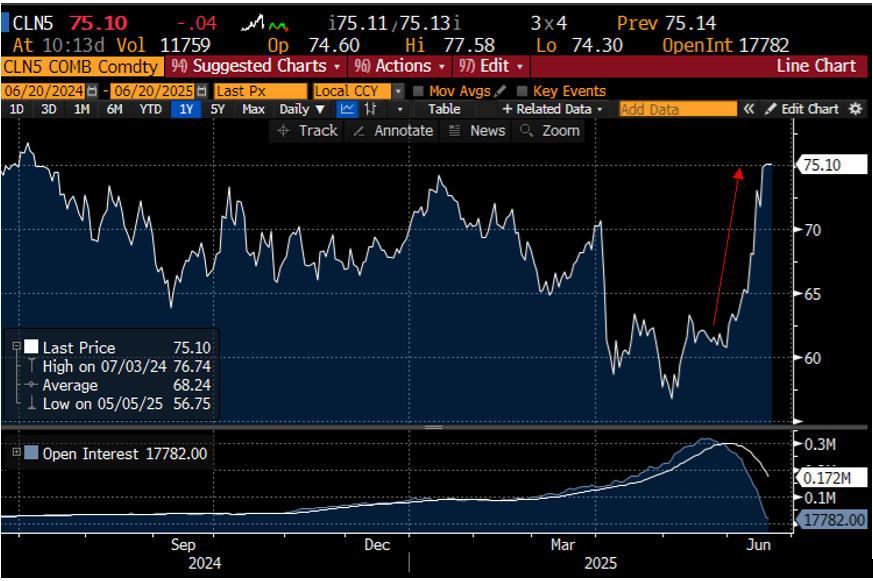
Energy stocks have responded favorably to the rise in crude oil, the sector is up +8.2% in June and is the best performing of the S&P 500 sectors for the month. Defense stocks have also seen short-term positive sentiment as they typically do in times of heightened global conflict.3
For the time being, the conflict is contained regionally, and US markets have generally weathered these conflicts in the past, although the prospect of volatile and higher energy prices could become a headwind. The potential for larger scale operations that may include direct US military involvement means it will be closely monitored.
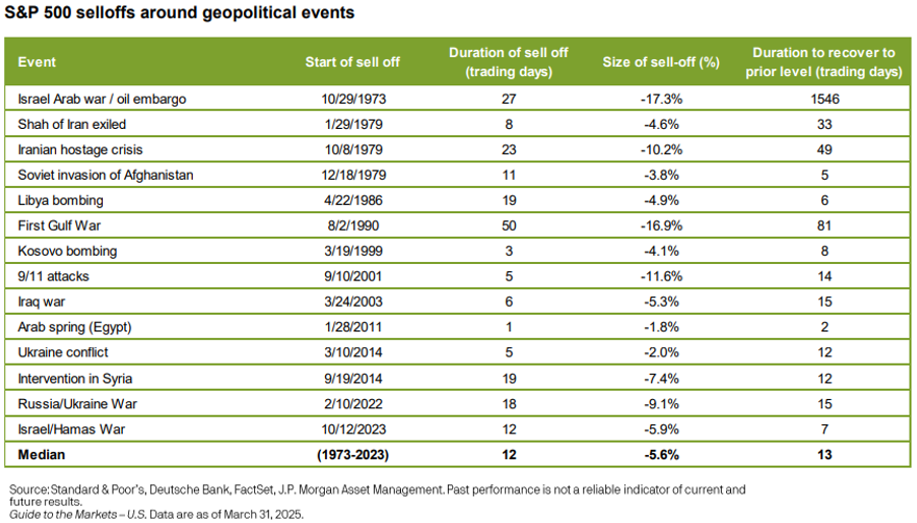
In case of further geopolitically driven market declines, keep in mind that historical data suggests these shocks are typically short-lived in the markets with swift recoveries unless economic fundamentals tangibly deteriorate. The table below from JPMorgan shows the market reaction to historical geopolitical events:
The Fed
On June 18, 2025, the Federal Open Market Committee (FOMC) decided to hold the federal funds rate steady at 4.25%–4.50%, unchanged since December 2024. This move has fueled tension with the White House, as President Trump escalates demands for lower rates, sharply criticizing Federal Reserve Chair Jerome Powell.
Powell emphasized that the Fed is not rushing to cut rates, with the need for more data to assess the economy’s direction, particularly given uncertainties around tariffs and trade policy. However, in the “dot plot” the committee maintained its expectation for 2 rate cuts before the end of the year, so cuts remain on the table in the back half of the year. The Fed Funds Futures market is pricing these cuts in at the September and December meetings.4,5
Regarding Tariffs, Powell stated: “Everyone that I know is forecasting a meaningful increase in inflation in coming months from tariffs because someone has to pay for the tariffs…some of it will fall on the end consumer.”
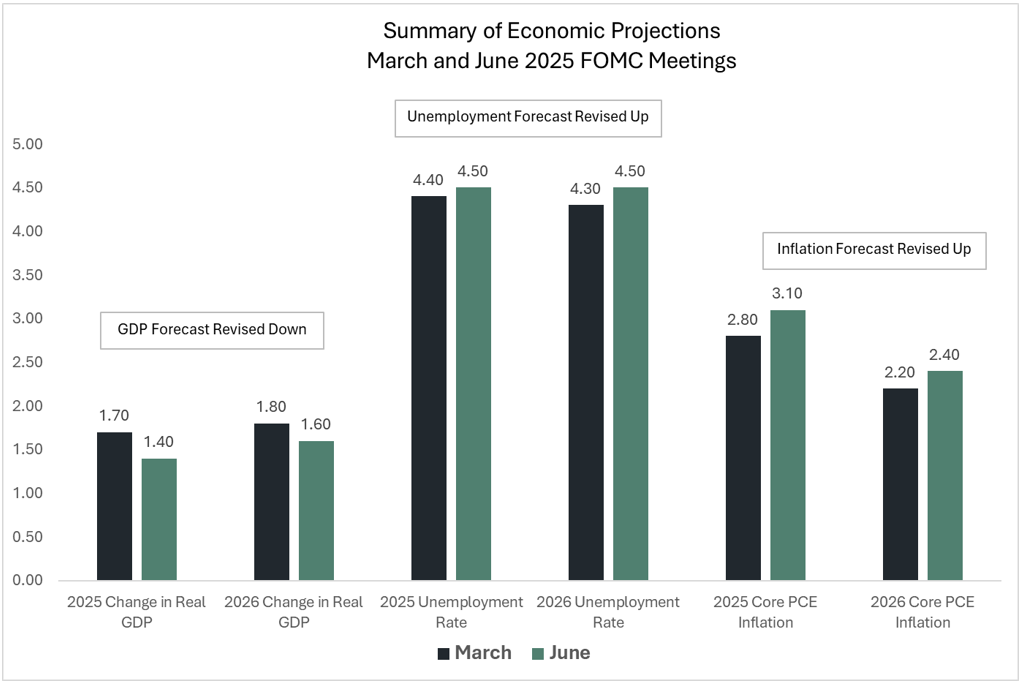
The Committee’s updated projections show expectations for slower GDP growth alongside higher inflation and a higher unemployment rate – all moving in the wrong direction relative to the Fed’s policy goals:6
The continued strength of the US economy has allowed the Fed to maintain its focus on inflation, particularly with the uncertain impacts of tariffs on consumer prices. The unemployment rate is holding steady at 4.2% as of May and Non-farm Payrolls have continued to grow, averaging 124,000 jobs added per month for the first 5 months of the year.7,8
Powell highlighted the strength of the US economy: “The U.S. economy has defied all kinds of forecasts for it to weaken, really over the last three years, and it’s been remarkable to see … again and again when people think it’s going to weaken out. Eventually it will, but we don’t see signs of that now.”
The FOMC is “well positioned to wait,” as Powell described the Fed’s cautious stance on rate cuts, supported by a robust economy amid uncertainty. In the second half of 2025, economic data will more clearly show the impact of tariffs on consumer prices, while trade deal progress could offer greater clarity on the outlook.
Our comprehensive Quarterly Update, due in early July, will provide a detailed review of the historic quarter and an outlook for the second half of 2025. In the meantime, our team is closely monitoring these market moving currents. Please don’t hesitate to reach out with any questions or concerns.
Footnotes:
- Morningstar Direct
- Bloomberg Market Data
- Morningstar Direct
- Federal Reserve https://www.federalreserve.gov/monetarypolicy/files/monetary20250618a1.pdf
- CME Group Fedwatch https://www.cmegroup.com/markets/interest-rates/cme-fedwatch-tool.html
- Federal Reserve https://www.federalreserve.gov/monetarypolicy/files/monetary20250618a1.pdf
- FRED, Federal Reserve Bank of St. Louis (https://fred.stlouisfed.org/series/UNRATE )
- FRED, Federal Reserve Bank of St. Louis (https://fred.stlouisfed.org/series/PAYEMS )
The views expressed herein are those of John Nagle on June 20th, 2025 and are subject to change at any time based on market or other conditions, as are statements of financial market trends, which are based on current market conditions. This market commentary is a publication of Kavar Capital Partners (KCP) and is provided as a service to clients and friends of KCP solely for their own use and information. The information provided is for general informational purposes only and should not be considered an individualized recommendation of any particular security, strategy or investment product, and should not be construed as investment, legal or tax advice. Different types of investments involve varying degrees of risk, and there can be no assurance that any specific investment or strategy will be suitable or profitable for a client’s investment portfolio. All investment strategies have the potential for profit or loss and past performance does not ensure future results. Asset allocation and diversification do not ensure or guarantee better performance and cannot eliminate the risk of investment losses. The charts and graphs presented do not represent the performance of KCP or any of its advisory clients. Historical performance results for investment indexes and/or categories, generally do not reflect the deduction of transaction and/or custodial charges or the deduction of an investment management fee, the incurrence of which would have the effect of decreasing historical performance results. There can be no assurances that a client’s portfolio will match or outperform any particular benchmark. KCP makes no warranties with regard to the information or results obtained by its use and disclaims any liability arising out of your use of, or reliance on, the information. The information is subject to change and, although based on information that KCP considers reliable, it is not guaranteed as to accuracy or completeness. This information may become outdated and KCP is not obligated to update any information or opinions contained herein. Articles herein may not necessarily reflect the investment position or the strategies of KCP. KCP is registered as an investment adviser and only transacts business in states where it is properly registered or is excluded or exempted from registration requirements. Registration as an investment adviser does not constitute an endorsement of the firm by securities regulators nor does it indicate that the adviser has attained a particular level of skill or ability.