
Quarterly Investment Research Note – July 13th, 2025
Market Outlook Summary
- Point-to-point the S&P 500 finished the first half of the year up +6.20% but intense volatility, centered around an upheaval of trade policy, has characterized most of the year thus far. The April 2nd tariff announcements triggered an acceleration of a global equity sell-off that quickly spilled into currency and fixed income markets, ultimately prompting the White House to reverse course on its trade rhetoric. At its lows in April, the S&P 500 had dropped -18.75% from its highest point based on closing levels before fully recovering in June.1
- International stocks have significantly outperformed their US counterparts for the year, boosted by a weakening US dollar and a rotation to the undervalued markets. The outperformance was broad-based around the world with the MSCI EAFE Index returning +19.45%, the MSCI Emerging Markets Index +15.27% and the MSCI World Ex US Small-Caps +20.79% for the year.2
- After the swift recovery, the S&P 500’s 22x forward P/E is back to the “fully valued” state at which it started the year. The top 10 companies in the index continue to make up nearly 40% of the total weight, leaving investors increasingly exposed to the outcomes of those few large companies. The average S&P 500 stock trades at a discount to the top-line at 16.7x forward P/E.3
- Analysts have revised 2025 S&P 500 earnings estimates down throughout the year amidst economic uncertainty. The current estimates are for earnings growth of 8.5% for the year, down from +15% to start the year. 2026 estimates continue to price in an inflection upwards, now at +13.9% growth for that year.4
- The bond market has performed well. Bloomberg US Aggregate Bond Index returned 4.02% during the first half. Treasury yields have oscillated around investor sentiment, economic data, monetary policy expectations and government deficit concerns but have remained range bound. Overall, the benchmark 10-year Treasury yield has fallen from 4.58% to 4.24% as of 6/30/25.5,6
- Credit spreads widened during the equity sell-off in April, most notably in High Yield issues but quickly narrowed. Spreads currently trade at historical tights across collateral types.
- The economy technically shrank in Q1 due to a large spike in Net Imports front-running tariffs. That distortion is likely to reverse in coming quarters. Recession forecasts picked up during the first half of the year but again the US economy has displayed resilience with the hallmark being a strong labor market.7
- The Federal Reserve is in the crosshairs of the White House as they have held off on cutting interest rates considering uncertainty around potential tariff-induced inflation. The FOMC forecasted 2 rates cuts in the 2nd half nonetheless – this aligns with current market expectations. The Fed will be a center of attention – particularly given the political pressure on Chair Jerome Powell as he finishes out his term next year.8
Equity Markets Mid-Year Summary
The 2nd quarter of 2025 will go down in history as one of the wildest, most eventful quarters in capital markets. Investors grappled with the President’s plan to re-work trade deals with everybody, all at once, using a shock-and-awe approach that was haphazardly rolled out and communicated.
When President Trump retreated a week after the announcements, setting a 90-day pause, the market quickly decoded the tariffs as a negotiating tactic and not the long-lasting policies. The April 9th rally in the S&P 500 was the single best day for the index outside of the Great Depression and Global Financial Crisis. The pause allowed for a calm to settle in around the trade rhetoric.
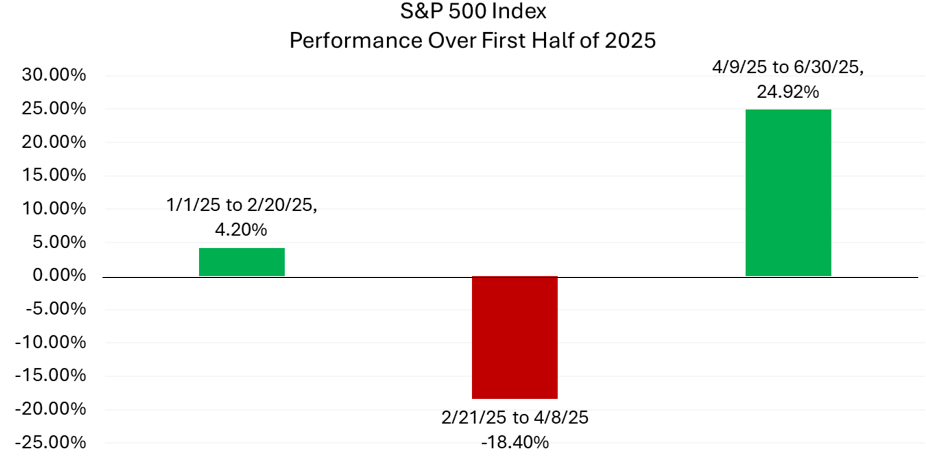
Markets bounced +24.92% from the April 8th low through the end of the quarter. Trade discussions moved in a positive direction, particularly with China, allowing investor attention to turn back to the ongoing secular trend of Artificial Intelligence (AI) playing out across multiple sectors. Other aspects of fiscal policy, including extending tax cuts, de-regulation and M&A activity came back into the narrative as net contributors to growth and increasing risk appetite within capital markets.9
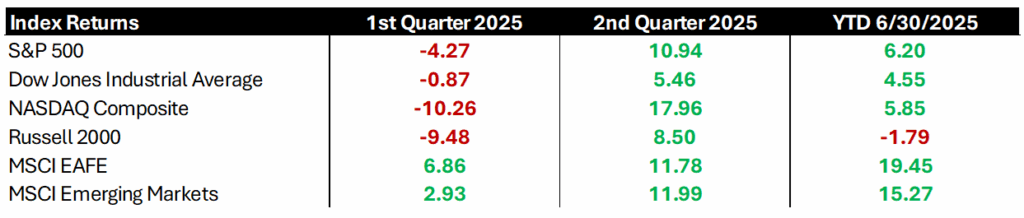
The S&P 500’s +10.94% gain marked its best quarter since Q4 2023 but lagged International stocks. After trailing the S&P 500 by more than 35% cumulatively over the past two years, the MSCI EAFE Index’s strong performance in the first half of 2025 has been a notable reversal in favor of investors that stuck with principle of global diversification even as recent performance narrowed around mega-cap growth stocks in the US.10
The weakening dollar is a tailwind for US investors in International stocks. Currency effects have accounted for over half of the MSCI EAFE’s total return in US dollars this year, but robust earnings and cheap multiples expanding contributed heavily to returns as well. In Europe, better than expected economic data and earnings drove the Eurozone markets to gain +31.3% for the first half of the year. Emerging Markets were likewise strong, returning +11.99% in the 2nd quarter.11
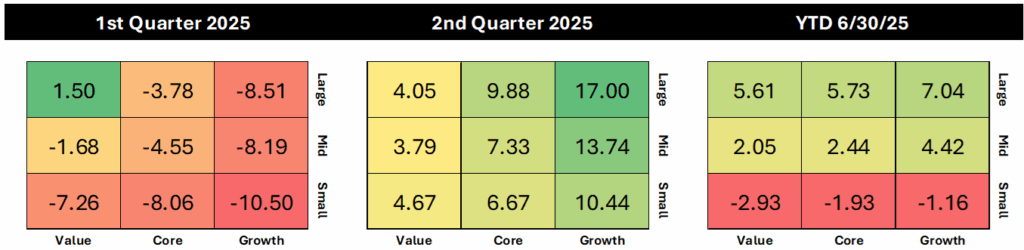
In the US, Large-caps have led Small-caps and the resurgence in Growth stocks in the 2nd quarter have the Large-cap Growth style in the lead for the year. Small-cap stocks struggled as economic expectations worsened and factors like weaker pricing power related to inputs and wages were seen as potential headwinds from trade and immigration policy.
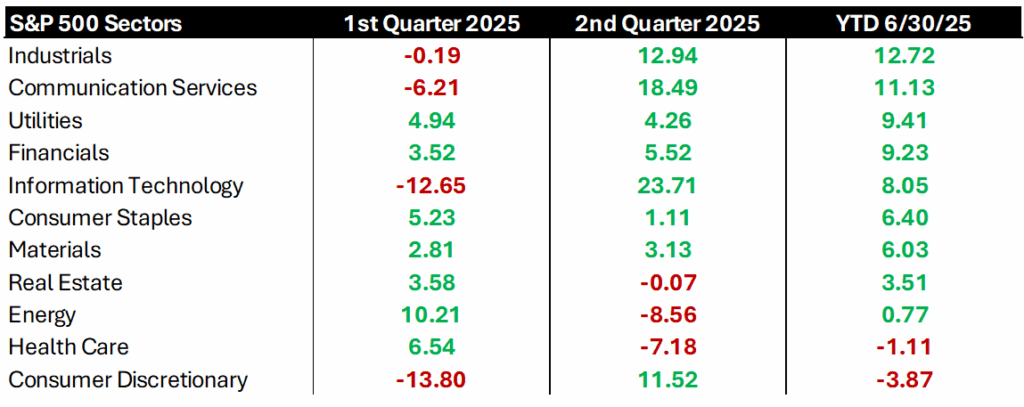
Industrials led all sectors during the 1st half but participation was broad-based and strong across multiple sectors. Industrials and Utilities are second-order beneficiaries of the ongoing build-out of AI infrastructure. Technology stocks saw a huge rally in the 2nd quarter as tensions cooled around trade. Health Care stocks have faced a political and regulatory headwind post-elections and have seen several major pharmaceutical companies report disappointing clinical results.12
The takeaways from the 1st half are abundant for investors, but these three principles resonate the most:
- Staying invested: the market turned on a dime out of nowhere after a social media post by the President and rallied 11% over the course of a few hours. There was no signal the tariff pause was coming so it was critical to stay invested during the turbulence to capture this upswing. Staying invested, even through periods of uncertainty, continues to be one of the most effective ways to compound in equities.
- It’s about better or worse, not good or bad: the market operates relative to current expectations. Incremental improvements that progressively make the situation better (even if still “bad”) are typically positive catalysts for market recoveries.
- The market is forward-looking: stocks have continued to rally to all-time highs in-spite of a negative GDP print, a decline in near-term earnings estimates and without any assistance from monetary policy. The market historically bottoms well before the data comes through because it is always looking forward. Keep this in mind as we continue to see the short-term impacts to economic data and earnings from policy in the coming months.
Fixed Income Markets Mid-Year Summary
In the bond market, the yield curve experienced a bull “steepener,” meaning the short-end (2-year US Treasury for example) fell more than long-term yields (10-year US Treasury). The 2-year Treasury fell from 4.25% to start the year to 3.72% at the end of the quarter. The 10-year US Treasury went from 4.58% to 4.24%. The 20-year and 30-year Treasury yields were essentially unchanged at the end of the quarter, but these issues experienced significant volatility during the 1st half of the year.13
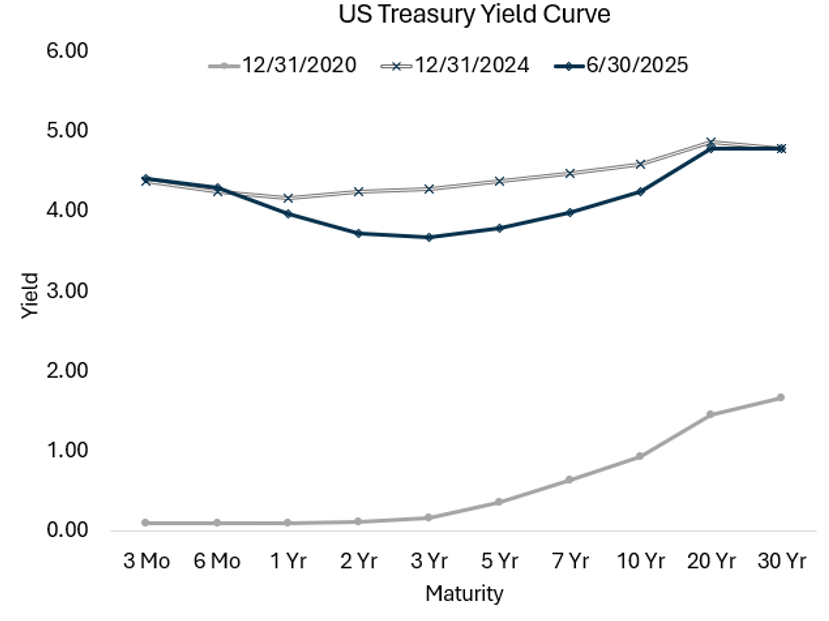
A bull steepening is often indicative of an impending rate-cut cycle although the Federal Reserve has thus far held their pause on cutting rates. The environment has been nonetheless very positive for fixed income investments. The Bloomberg US Aggregate Bond Index was up +4.02% during the first half.14
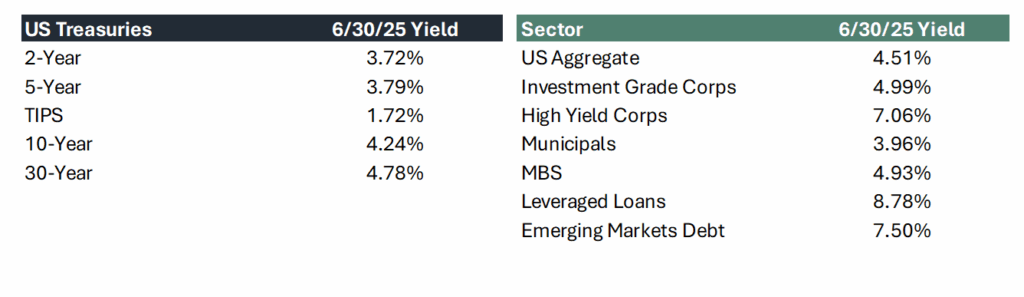
During the first half of the year, US Investment Grade and High Yield corporate bonds returned +3.79% and +4.57% respectively. Municipal bonds were a notable laggard, losing -0.35% during the first half. Heavy issuance, rising yields (the long-end of the Muni curve rose 0.50%-0.70% vs. 0.10% in Treasuries) amid concerns about the pending tax bill weighed on the asset class. The recent news that the federal tax exemption was preserved for all municipal bonds relieves some of these concerns.15
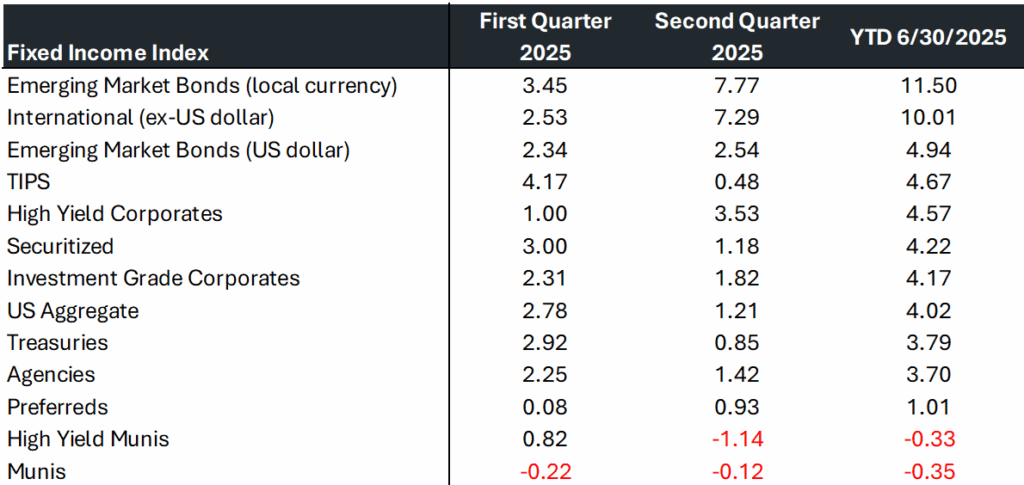
The falling US dollar benefitted fixed income issues denominated in other global currencies. International bonds, and in particular, those issued in developing countries delivered outsized returns in the first half of the year. When investing in bonds denominated in local currency (non-US dollar), the investor is exposed to exchange rates movements as part of their total return which is a positive contributor if the US dollar weakens vs. those local currencies.
Overall, fixed income was a contributor to portfolio returns with core bonds preserving capital and providing income throughout most of the 1st half of the year. Satellite exposures to credit and international bonds delivered a significant (and rare in its magnitude) boost to total returns from the bond portfolio. Rates were volatile but range-bound after settling down in the 2nd quarter – an environment we expect to continue.
Economy Summary
The US economy continues to be best described as “slowing but growing” in our view. The 1st quarter’s negative Real GDP print was largely a factor of a large spike in Net Imports (Imports decrease GDP, Exports increase GDP) that was seen as front-running the impending tariffs. Retailers and Suppliers rushed orders to get them across the border and build-up inventory to avoid paying the tax.16
Trade is a relatively small piece of economic growth that is heavily driven by Consumption. The two more important components of economic growth, Personal Consumption Expenditures and Gross Private Domestic Investment were both positive for the quarter.
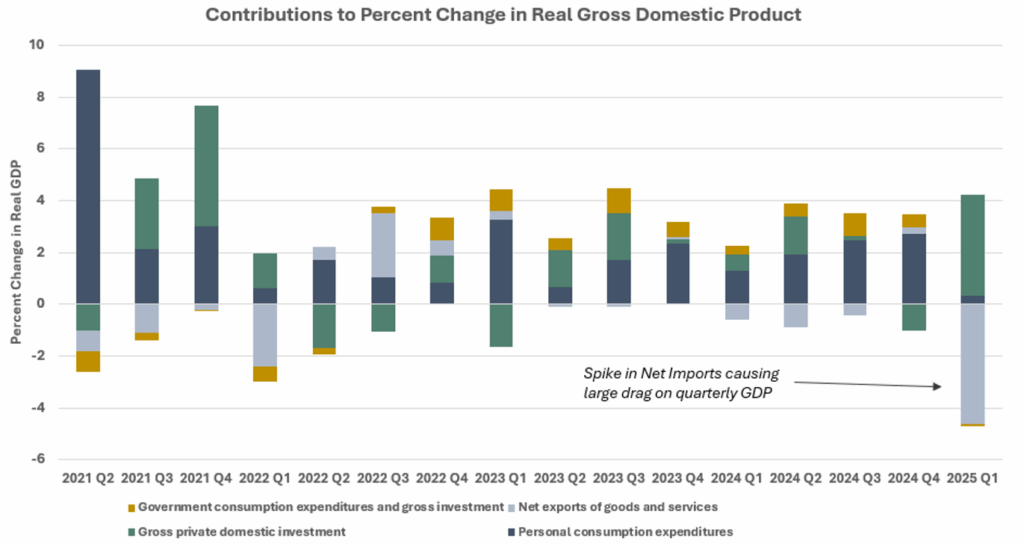
We expect short-term oddities like this to pop-up as radical policies cause short-term reactions from consumers and businesses. The trade data will moderate over the coming quarters and likely reverse as tariffs slow down imports. Overall, economic growth is projected to be positive for the full year, again fading the recession calls that seemingly arrive annually.
The largest reason for the continued growth of the economy is the US consumer. Consumption makes up nearly 70% of US economic growth and the consumer, while decelerating from the post-COVID exuberance, remains on solid footing with strong balance sheets, rising wages and a stable job market.
The labor market has softened over recent months. Job growth remains solidly positive, but the average number of jobs added per month has steadily slowed to 130,000 over the past 6 months. The unemployment rate has also shown extreme consistency, with only minor fluctuations between 4% and 4.2% for the past 12 months.17
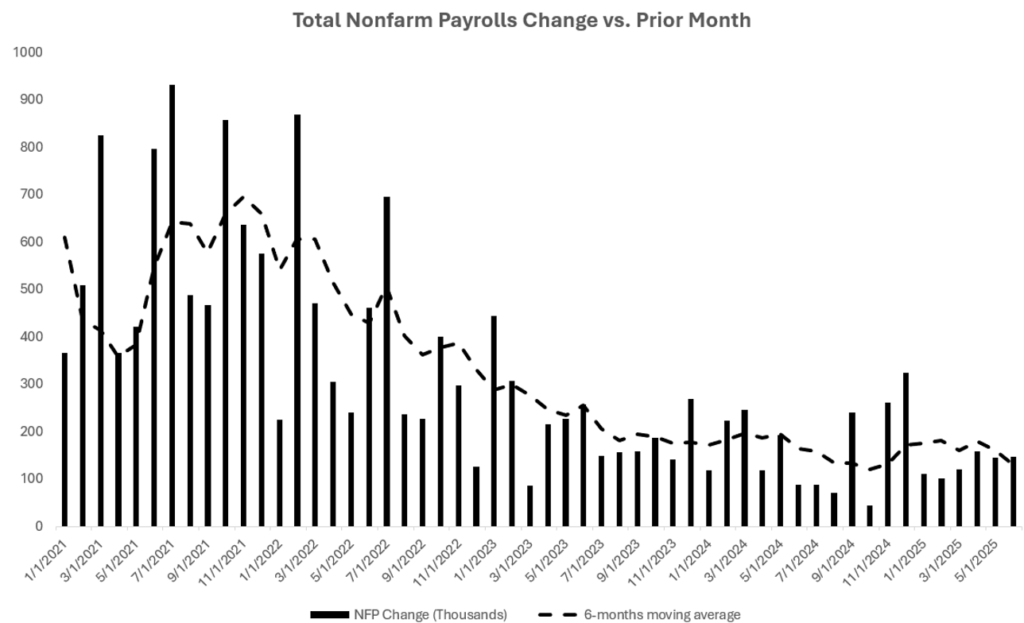
Additionally, wage growth remains positive but also has slowed. Average hourly earnings year-over-year growth has cooled from a high near 6% in March 2022 to 3.7% as of June 2025 – still high relative to pre-COVID levels but more indicative of a balanced labor market. Layoff announcements have risen in tech, finance, and media, but total jobless claims remain relatively low, indicating layoffs are still not widespread. Job openings are trending lower, and quit rates, often seen as a sign of worker confidence, have normalized, further pointing to reduced labor market tightness.18
Inflation remains muted and has continued to make progress towards the Fed’s 2% target although it remains firmly above it with Core PCE reading 2.7% in May 2025. Housing and insurance costs are proving to be stickier than expected. The outlook for inflation in the 2nd half is murky as there has so far been limited read-through on the impacts of tariffs in the official data.19
Our view is that the front-running of imports and build-up of inventories may delay the impact. Tariffs will almost certainly begin to affect official inflation data in the coming months – the US Treasury reports nearly $125 billion in tariffs collections so far this year and these will at least partially be passed on to the consumer and create higher inflation readings. The question is whether this is a one-time, “transitory,” elevation and how that will be perceived by the consumer and central bankers.20
The Federal Reserve is closely balancing the above dynamics. The outlook is shaped by the uncertainty that Chair Powell has harped on throughout the year largely driven by the seismic ebbs and flows of changing trade policy.
The Fed has maintained its holding pattern as it waits for further confirmation on inflation, the jobs market and potential ripple effects of tariff policy on these data sets. The market is currently pricing in 2 rates cuts, just as the Federal Open Market Committee (FOMC) projected at its latest meeting in June 2025. The FOMC also projected higher unemployment, lower economic growth and higher inflation for 2025 than it had previously done so the group is likely to have evaluated that the recent data has been changing in challenging ways for monetary policy.21
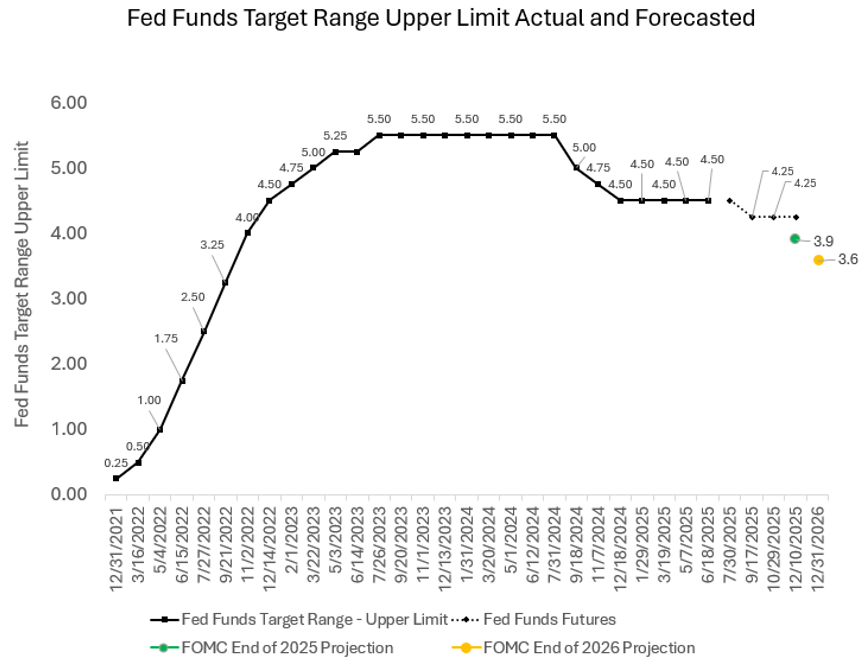
If price pressures arise from tariffs or if inflation continues to plateau above the Fed’s 2% target while the jobs market remains on solid footing, it is possible that the Fed will hold off on rate cuts. The current policy is somewhat restrictive but with full employment and a growing economy it gives the Fed clearance to be patient as it makes it way to the neutral rate.
As we begin the 2nd half of the year, tariff rhetoric has again ramped up as well as the political pressure on Fed Chair Powell that will have monetary policy at the forefront of investors attention. Expect volatility to be driven by policy – trade, fiscal, monetary and geopolitical. The fundamentals of the economy and the markets are on solid footing as our base from the beginning of the year is still in place and makes for a positive environment for equities:
- Moderate economic growth, supported by strong consumer, capital investment and increased productivity.
- Neutral monetary policy with a cautious outlook on future easing.
- Broad-based and strong corporate earnings growth in 2025 and 2026.
- Renewed activity in equity capital markets (M&A and IPOs).
- Intermittent volatility surrounding trade policy that may impact currency exchange rates.
- Range bound but volatile interest rates.
- Low and stable inflation.
- Tight corporate credit spreads.
If you cut through the noise and anchor your decisions to the fundamentals above, maintain a long-term perspective, and practice the principles of thoughtful portfolio management we believe the outcomes will end up positively in investors favor. As always, we will stay in close touch throughout the back half of the year, please reach out to any of our team members with questions or comments as needed.
Footnotes:
- Morningstar Direct Data
- Morningstar Direct Data
- FactSet Earnings Insight
- Bloomberg Data
- Morningstar Direct Data
- US Treasury https://home.treasury.gov/policy-issues/financing-the-government/interest-rate-statistics
- US Bureau of Economic Analysis https://www.bea.gov/data/gdp/
- Federal Reserve https://www.federalreserve.gov/monetarypolicy/fomccalendars.htm
- Morningstar Direct Data
- Morningstar Direct Data
- Morningstar Direct Data
- Morningstar Direct Data
- US Treasury https://home.treasury.gov/policy-issues/financing-the-government/interest-rate-statistics
- Morningstar Direct Data
- Bloomberg Data
- St. Louis Fed FRED Database https://fred.stlouisfed.org/
- St. Louis Fed FRED Database https://fred.stlouisfed.org/
- St. Louis Fed FRED Database https://fred.stlouisfed.org/
- St. Louis Fed FRED Database https://fred.stlouisfed.org/
- US Treasury https://fiscaldata.treasury.gov/datasets/daily-treasury-statement/operating-cash-balance
- Federal Reserve https://www.federalreserve.gov/monetarypolicy/fomccalendars.htm
The views expressed herein are those of John Nagle on July 13th, 2025 and are subject to change at any time based on market or other conditions, as are statements of financial market trends, which are based on current market conditions. This market commentary is a publication of Kavar Capital Partners (KCP) and is provided as a service to clients and friends of KCP solely for their own use and information. The information provided is for general informational purposes only and should not be considered an individualized recommendation of any particular security, strategy or investment product, and should not be construed as investment, legal or tax advice. Different types of investments involve varying degrees of risk, and there can be no assurance that any specific investment or strategy will be suitable or profitable for a client’s investment portfolio. All investment strategies have the potential for profit or loss and past performance does not ensure future results. Asset allocation and diversification do not ensure or guarantee better performance and cannot eliminate the risk of investment losses. The charts and graphs presented do not represent the performance of KCP or any of its advisory clients. Historical performance results for investment indexes and/or categories, generally do not reflect the deduction of transaction and/or custodial charges or the deduction of an investment management fee, the incurrence of which would have the effect of decreasing historical performance results. There can be no assurances that a client’s portfolio will match or outperform any particular benchmark. KCP makes no warranties with regard to the information or results obtained by its use and disclaims any liability arising out of your use of, or reliance on, the information. The information is subject to change and, although based on information that KCP considers reliable, it is not guaranteed as to accuracy or completeness. This information may become outdated and KCP is not obligated to update any information or opinions contained herein. Articles herein may not necessarily reflect the investment position or the strategies of KCP. KCP is registered as an investment adviser and only transacts business in states where it is properly registered or is excluded or exempted from registration requirements. Registration as an investment adviser does not constitute an endorsement of the firm by securities regulators nor does it indicate that the adviser has attained a particular level of skill or ability.