
Market Update – August 1st, 2025
Federal Reserve Summary and Outlook
As expected, the Federal Reserve held interest rates steady this week, keeping the Fed Funds Target Range at 4.25% to 4.50% for the fifth consecutive meeting. The decision comes amidst a complex set of economic conditions that has divided the Fed, as well as unprecedented political pressure from the White House.
Two governors, Christopher Waller and Michelle Bowman, dissented against the decision, arguing that the Fed should have cut rates, a sign of the unusual split in the FOMC that usually delivers policy actions in nearly full agreement. This was the first time two governors dissented at a meeting since 1993.
There are arguments for cutting rates and for maintaining the current rate given the shifting dynamics of the economy in its current state and we outline them both below:
The Arguments for Cutting Rates Now
Waller and Bowman laid out the case for resuming rate cuts in recent public comments focusing on the Fed’s dual mandate:
- Getting ahead of a cooling labor market
The labor market has undoubtedly softened off in recent months. The year, Total Nonfarm payrolls has averaged about 85k jobs/month, down from 168k in 2024 and 217k in 2023. This morning’s payrolls came in well below expectations and were accompanied by significant downward revisions to the prior 2 months. The latest data shows jobs growth of only 106k in total over the past 3 months.1
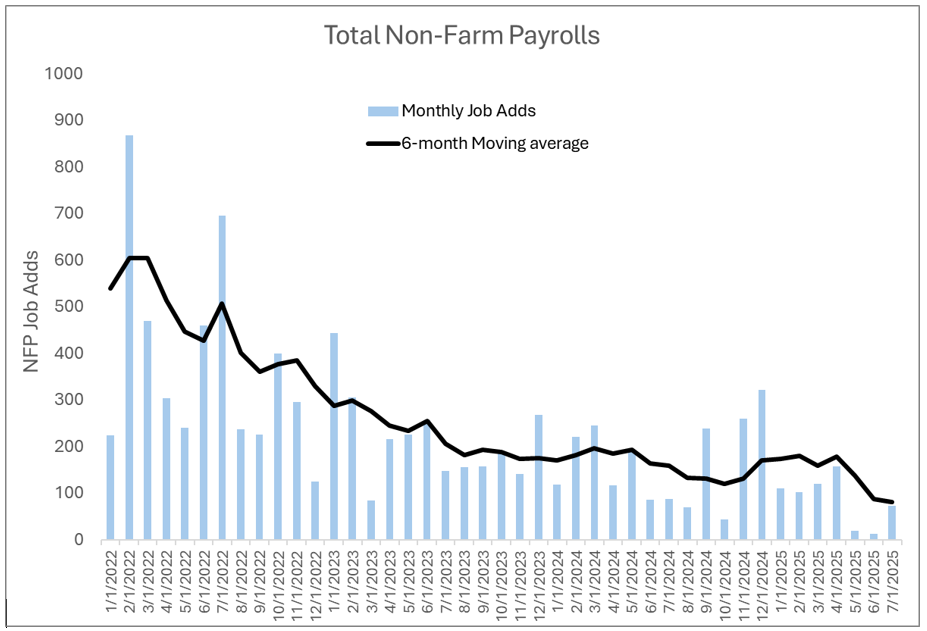
Waller added that despite the low headline unemployment rate, private-sector hiring has stalled; and unemployment among recent college graduates has surged.
The argument is that the Fed should be proactive and not wait for outright deterioration in the labor market before easing because at that point it may be “too late.”
- The Disinflation trend is intact because tariffs are transitory
Tariffs have driven uncertainty in the inflation outlook and that logically lessens the Fed’s impulse to cut rates. Tariffs represent an increase in price of goods imported to the US and somebody will ultimately pay it – if it’s the end consumer than that’s inflation.
The argument is that tariffs will lead to a small, one-time increase in prices that the Fed should largely ignore in its policy setting. Furthermore, the tariff impact on inflation has been muted so far, and less than economists expected so that should be considered as well.
The disinflation observed over the past three years has been significant. Core PCE has fallen from 5.6% in September 2022 to 2.8% as of June 2025.2 Fed officials projected Core PCE to end 2025 at 3.1% and 2026 at 2.4%, reinforcing that inflation is contained and that they expect further progress to the Fed’s 2% inflation target over time and therefore the Fed should move off restrictive levels.3
- The White House’s reasoning
The arguments from the White House come from different angles. The President has consistently harped on the interest costs of the Federal debt: today, the Federal Government is spending over $1 Trillion in interest payments on Treasuries annually.4 And the President has pointed to a frozen and expensive housing market across the US, particularly for first-time homebuyers.
From the Fed’s perspective these two items do not fall within their dual mandate of maximum employment and price stability. The Fed does not target interest rates to reduce the cost of federal borrowing – prioritizing this would compromise the Fed’s independence and risk politicizing monetary policy. And while housing affordability is influenced by interest rates, it’s not explicitly a target of the Fed. Additionally, affordability depends on multiple factors that the Fed can’t control, for instance, supply dynamics.
It is uncertain what impact the Fed lowering rates would have on intermediate and long-term rates that serve as the reference rate for consumer loans. The Fed controls the shortest point of the yield curve and the longer duration rates are determined by the open market. Recall that in 2024 when the Fed cut rates were lowered by 1%, the 10-year yield increased from 4.1% to 4.7% and mortgage rates were essentially unchanged.5,6
The Argument for Not Cutting Rates
The rest of the FOMC would argue that rates are currently restrictive to some degree, which is necessary to accomplish the Fed’s dual mandate as conditions exist today and their arguments mirror those of the above reasons for cutting rates:
- A Solid Labor Market
The labor market, while softening, remains “quite solid” according to Chair Powell. The chair has commented that labor market conditions are broadly in balance and consistent with maximum employment. And with unemployment hovering at 4.2%7 this means the Fed can focus on continuing to get inflation down to its 2% target.
This argument is losing steam as the labor market weakens, underscored by this morning’s payrolls number.
- Inflation remains above target and the tariffs impact is still uncertain
The Fed’s preferred inflation gauge, Core PCE, is at 2.8% as of yesterday’s June reading and has made scant progress during 2025. The reading came in higher than economists had expected.
Additionally, the impact of tariffs on inflation is uncertain and are just beginning to filter into the data that the Fed relies upon to interpret the economy and make decisions. Prices for Core Goods have risen sharply over the past 3 months:
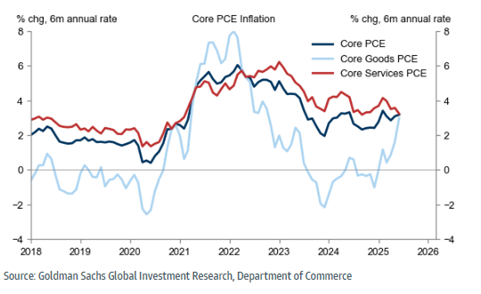
While this may prove temporary, as many acknowledge, Powell has emphasized that the Fed won’t cut rates until it’s confident that a short-term increase in goods prices isn’t triggering broader inflation and/or elevating long-term inflation expectations. University of Michigan 1-year inflation expectations are at their highest level since 1981.8
The result of these views, and the other factors at play, is the Fed remains in a “wait-and-see” posture. Powell and the majority at the Fed ultimately seem to believe that given the strength of the labor market, they have time to be patient with rate cuts and that a moderately restrictive rate is appropriate given the stickiness of inflation and the uncertainty regarding trade policy.
Post meeting, a September rate cut was priced out of the Fed Funds Futures markets, however, after the weak jobs numbers this morning, it flipped back and then some, now pricing in rate cuts in September, October and December (as of 9:15am CST). We expect volatility in policy-change expectations like this for the remainder of the year as the data comes in.
The Fed will continue to be data dependent as it evaluates the labor market and inflation and balances the risks of each part of the dual mandate. The inflation and jobs numbers released this week are emblematic of the conflicting data that the Fed is analyzing.
What does this mean for my portfolio?
The monetary policy outlook is one of many factors contributing to our overall asset allocation strategy, but it informs our views on some specific areas:
- With the Fed keeping rates elevated, yields on short-duration bonds, money markets, and Treasury bills remain compelling for now. This environment continues to reward patient capital in high-quality, lower-duration fixed income.
- Uncertainty about the Fed’s rate path and the inflation outlook means intermediate and long-term interest rates may remain volatile. Duration risk remains a consideration for bond investors, although less than in recent years given today’s higher interest rate regime. The barbell approach remains in favor.
- Credit risk is an important consideration as higher rates continue to weigh-on risky balance sheets (both public and private), particularly those exposed to floating rate obligations.
- In the equity markets, investors should expect some sentiment and valuations to swing as labor market data and inflation shift economic growth and Fed expectations. Additionally, as the Fed remains cautious, central banks elsewhere globally are cutting rates, adding to the momentum of International stocks.
We’ll keep in close touch as we sift through the market and economic developments with a close eye on the Fed in the last 4 months of the year. Please reach out to our team with questions/comments at anytime.
Footnotes:
- St. Louis Fed FRED Database https://fred.stlouisfed.org/
- St. Louis Fed FRED Database https://fred.stlouisfed.org/
- Federal Reserve https://www.federalreserve.gov/monetarypolicy/files/fomcprojtabl20250618.pdf
- St. Louis Fed FRED Database https://fred.stlouisfed.org/
- St. Louis Fed FRED Database https://fred.stlouisfed.org/
- St. Louis Fed FRED Database https://fred.stlouisfed.org/
- St. Louis Fed FRED Database https://fred.stlouisfed.org/
- St. Louis Fed FRED Database https://fred.stlouisfed.org/
The views expressed herein are those of John Nagle on August 1s, 2025 and are subject to change at any time based on market or other conditions, as are statements of financial market trends, which are based on current market conditions. This market commentary is a publication of Kavar Capital Partners (KCP) and is provided as a service to clients and friends of KCP solely for their own use and information. The information provided is for general informational purposes only and should not be considered an individualized recommendation of any particular security, strategy or investment product, and should not be construed as investment, legal or tax advice. Different types of investments involve varying degrees of risk, and there can be no assurance that any specific investment or strategy will be suitable or profitable for a client’s investment portfolio. All investment strategies have the potential for profit or loss and past performance does not ensure future results. Asset allocation and diversification do not ensure or guarantee better performance and cannot eliminate the risk of investment losses. The charts and graphs presented do not represent the performance of KCP or any of its advisory clients. Historical performance results for investment indexes and/or categories, generally do not reflect the deduction of transaction and/or custodial charges or the deduction of an investment management fee, the incurrence of which would have the effect of decreasing historical performance results. There can be no assurances that a client’s portfolio will match or outperform any particular benchmark. KCP makes no warranties with regard to the information or results obtained by its use and disclaims any liability arising out of your use of, or reliance on, the information. The information is subject to change and, although based on information that KCP considers reliable, it is not guaranteed as to accuracy or completeness. This information may become outdated and KCP is not obligated to update any information or opinions contained herein. Articles herein may not necessarily reflect the investment position or the strategies of KCP. KCP is registered as an investment adviser and only transacts business in states where it is properly registered or is excluded or exempted from registration requirements. Registration as an investment adviser does not constitute an endorsement of the firm by securities regulators nor does it indicate that the adviser has attained a particular level of skill or ability.